
BID Model - Give Clear, In-the-Moment Feedback
As leaders, most of us know that feedback matters. It’s described as a gift and is the one thing that can change performance if it’s embedded in an organisation's culture. But at the precise moment that it’s needed, it’s often avoided.
We might tell ourselves it’s not the right time or worry about it coming out ‘wrong’. We might even wait so long that by the time we do say something, the conversation feels irrelevant.
The problem is that when feedback is delayed, softened too much, or mixed up with different messages, people are left second-guessing. The person on the receiving end doesn't know what landed well, what needs to change or what we actually want from them next.
We use the BID model at OverTime Leader to help leaders give feedback clearly, simply and in the moment while it still means something.
The power of the model is in its simplicity. It helps leaders to stay focused on one message, keeps the conversation grounded in what actually happened and avoids sending mixed signals.
Great leaders don’t save feedback for formal moments. They give it frequently and regularly so their team can adjust in real time and there are fewer surprises later. Building the feedback muscle across the whole organisation helps shape a culture of stronger performance, clearer expectations and more intentional development over time.
Here’s how to use BID to prepare for a clear, useful feedback conversation.
What You’ll Need
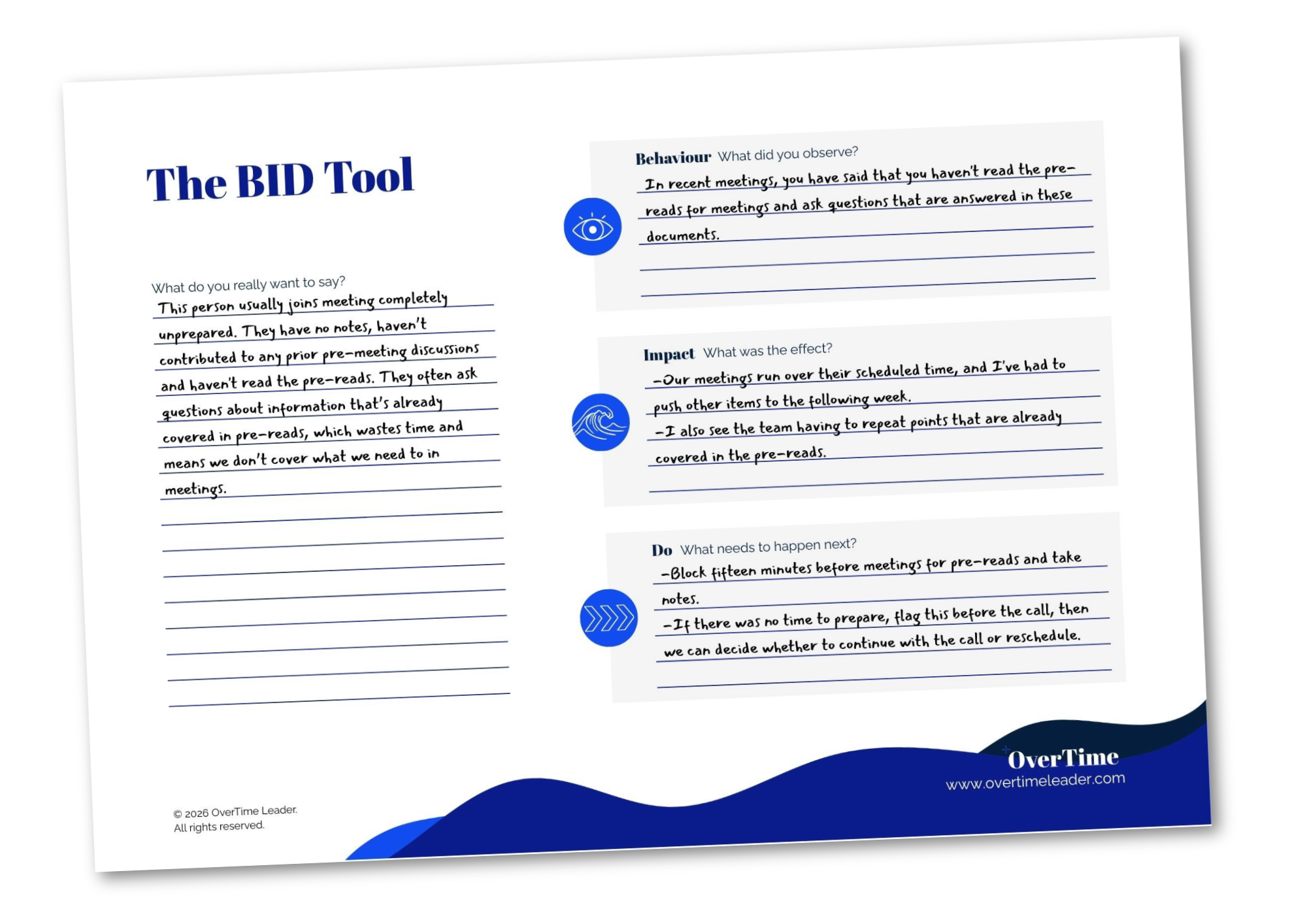
A printout of the BID worksheet
A pen
10 minutes of focused time
A real feedback conversation in mind (can be positive or constructive)
The process: How to run BID
1. Think about one feedback conversation you need to have. Is it something that you want someone to keep doing or something more constructive that needs addressing now? Keep it specific to just one key message so the feedback is easy to understand and act on. On the BID worksheet, write down what you really want to say to this person. No filter!
2. Now run your feedback message through BID. Start with B: Behaviour. Write down what you observed on the sheet. Keep this factual, specific and non-judgemental. Focus on what actually happened, rather than your interpretation of it.
3. Next, move to I: Impact. Capture the effect that the behaviour had. This could be the impact on the work, the team, the energy in the room or the wider business. Keep it simple and grounded in what the behaviour caused.
4. Finish with D: Do. Be really clear about what needs to happen next as a result of the impact. What would you like to see more of, less of or done differently? Keep this short and direct so the message is easy to land.
5. Think about how to lead the conversation: Do you need to be more direct and clear in your delivery (directive) or more curious and coach-like (facilitative)? Is the person already aware of the behaviour and the impact it is having? What question could you ask to open the conversation? Mark where you need to show up on the scale, then jot down how you will role model that style. This will help you deliver the message in a way that is both useful and easy to hear.
For example, you might be more directive by clearly naming the behaviour you saw and what needs to change. Or you might be more facilitative by asking how they think their behaviour landed and what they would do differently next time.
6. Choose the right moment and setting. Have the conversation as close to the moment as possible, while it is still relevant. Also think about what will help the other person hear it well. Do they need privacy, a bit of breathing space, or a calmer moment in the day? Pick a time and place that gives the conversation the best chance of landing well.
7. Make BID part of your leadership rhythm. The more often you give timely, clear feedback, the easier it becomes to give, hear and act on. Build it into your leadership rhythm and see how it helps your team grow, improve and adjust in real time.
Start with one clear conversation and build from there.
Let us know what shifts for you and your team.
Gillian
Download The BID Model
OverTime Leader needs the contact information you provide us to contact you about our products and services. You may unsubscribe from these communications at any time. For information on how to unsubscribe, as well as our privacy practices and commitment to protecting your privacy, please review our Privacy Policy.